Tuesday, February 2, 2010

The value of value.

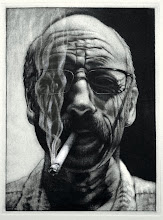
The term chiaroscuro has its roots in Italian, where it literally means the combination of light (chiaro) and dark (scuro). In our drawing class it refers to the technique of applying subtly blended shades of gray to imitate the varying intensities of light and shadow that occur when light is directed toward and reflected off three-dimensional forms, such as the white plaster forms we've been working with during drawing sessions. Chiaroscuro is a powerful too for defining the mass and volume of individual forms, for describing surface texture, and for establishing and clarifying the space that exists between objects. The value scales you created over this past weekend should help you in seeing and representing some of the subtle values that most people overlook is objects under a direct light.

When you think about creating a drawing that has a wide range of value, you have to consider that he white of our drawing paper is the brightest white that we have at our disposal for describing the highest level of illumination in a drawing. It's important to identify those areas of our drawing that will remain white. Once these are identified, we can proceed to push everything else back to an appropriate level of "nonwhiteness". If you squint your eyes at the subject, the lightest lights and the darkest darks should become evident.

Rarely do shadows appear as solid black, they usually reflect some light, and they usually have a subtle gradation that changes throughout the shadow area, be on the lookout for that.It is usually slightly darker near the edges of the shadow where it comes into direct contact with the lighter areas (remember simultaneous contrast) and lighter toward the center of the shadow.

We really can't duplicate the intensity of a brightly lit still life by relying on the white of our paper, but we can come close to the dramatic effect of that by exaggerating the darks. Pushing the values down a step or two on the value scale will allow the highlights in your drawing to appear to glow with the same intensity and clarity as your perceptual experience.

We'll get a bit more complicated and challenging this evening and see how our drawing experiences are helping us to see better. Please refer to the post of September 22, 2009 for additional stuff about value.

See you tonight.


Thursday, January 28, 2010

Teri Frame Lecture

Tonight is Teri Frame's lecture in the Clay studio, KV035, at 6:00, so that's where we'll meet first. I wasn't able to get back to campus in time to see her performance last evening, but all reports are that it was totally fascinating. It was tapped, so we may get a chance to see it if it gets posted somewhere. See you this evening in the clay studio, afterwards we'll continue exploring composition and value. See you soon.

Wednesday, January 20, 2010

Project #1 Perspective

Last night we discussed the first out-of-class project and did some preliminary studies. Please review the earlier post that I mentioned so that you can visit the perspective sites. The project will be a two-point perspective cityscape. I recommended that you look through magazines and web searches for cityscapes that might provide inspiration. Of course you'll be creating this city scape based on your knowledge and experience with linear perspective rather than drawing one from observation. Your city can be anything that you imagine it to be as long as your perspective is accurate. We will begin the process during class on Thursday after the 6:00 gallery talk by Valerie Fuchs, who will be opening an exhibition in our gallery. Do a Google search for "cityscapes drawings" to see some various examples of how artists have handled this subject. We'll go into all the intricacies of this project and what to avoid on Thursday.

Don't forget that the gallery talk begins at 6:00 in the gallery, just down the hall from our studio off of the Ogle lobby. Try to get there a few minutes before 6:00 so you'll be there when she starts.

See you tomorrow evening.

Thursday, January 14, 2010

Perspective, as in LINEAR...

Hey drawers, if you look back through the blog to August 28, 2009, under the post titled "PERSPECTIVE", there are a few links that will take you to some places for a pretty good introduction to, explanation of, and visual examples of Linear Perspective. I think the information is pretty good and should help you to get a pretty quick grasp of some of the principles we'll be exploring this evening in class. It'll also allow you to travel around the blog to previous semesters and see some examples of previous work that has come out of this class, including some perspective drawings. See you this evening.

Thursday, January 7, 2010

Spring 2010

We're about to start another semester exploring the drawing process and its supporting foundation of the basics, although it seems like we just finished the fall semester. Gosh, I guess we did. I've posted the syllabus on ONCOURSE so that you can have early access to the supply list and the class calendar.  There have been a few changes since last semester, which we'll discuss on Tuesday evening during our first meeting. Between now and then, please peruse our blog over the past few semesters to see and read what some of the previous F100 classes did with projects and how they responded to some of the discussions. I think you'll enjoy it.  See you Tuesday evening. 

Tuesday, December 15, 2009

Final Projects

The group critique started with groups of four critiquing four other drawings from another group. We had tried this process before, but this time all the kinks got worked out before hand and the discussion process was very productive and constructive.


After the group critique, Kirsten, Craig, and Lori kept going after everyone else had left the studio.


Tana Tidd's horse gear.


Sam Chumley's self portrait with mask.


Lacy Crouthamel's self portrait with mask.


Jessica Hagedorn's autobiographical still life.


Craig Banks' worm's eye view still life.

We got the things wrapped up on December 8 with our best critique of the semester. Unlike previous sessions, this one was engaging until the very end, and then there were a few who stayed longer to continue discussing the drawings. It was pretty amazing to see how much growth there had been in every one's work, and for many this was a first time experience with drawing.

Once I started to review the portfolios that growth became even more evident, and there seemed to be a direct correlation between the development of drawing skills and activity in the sketchbooks. To those who used their sketchbooks to increase observation and manual skills, I hope you too can see the improvements.

Good job everyone and hope to see you next semester.

Saturday, November 21, 2009

Drawing toward the final project...

Tana Tidd


Richelle Greenblat


Jessica Hagedorn


Gilbert Garcilazo


First, I didn't get the chance to get examples shot of the alternative self portaits, so I'm including a few here that were submitted a little later that I still had in my office.

The final project has been assigned so everyone is on their way to getting fully absorbed in the details of that. Options include a "worms-eye" or a "bird's-eye" view of a still life, no horizon line or back edge; an additive and reductive drawing of a still life with interesting and engaging forms; a self-portrait with a mask, and finally an open-ended option that was to be presented as a proposal with to-scale sketches. I had one of those, but the plan has since changed back to one of the other options. So we'll essentially be looking at a group of drawings based on option #1, #2, or #3. I'm sure there may be variations on those, but as long as the gist of those ideas is there, then the only surprises will be in the strength of the executions of the images. I anticipate a group of drawings that will clearly exhibit strong developments in the skills and comprehension of composition, effective use of the art elements, critical thinking skills to resolve the creative problems that manifest during the execution, ideas that are well considered and unique, and well crafted final projects.

We won't be meeting until after the Thanksgiving break on December 1, so I am hopeful that everyone will utilize whatever time they can grab over the holiday to explore this final project. Have a great Thanksgiving!